Where to invest as hot inflation and higher rates loom over markets, according to one research firm
JOHANNES EISELE/AFP via Getty Images
- A new class of stock winners could emerge as markets enter a period of hot inflation, NDR said.
- The research firm said value stocks tend to outperform in periods when inflation was rising.
- Real estate, energy, materials, and industrials could also present opportunities.
The Iran war could be driving a paradigm shift in markets that creates a new class of stock winners.
Just as investors were growing accustomed to the idea of an ideal scenario of disinflation and steadily rising growth, the spike in oil prices has threatened to push the market into a new regime, according to Ned Davis Research. High inflation and lower growth could be the result of the conflict.
In periods of rising inflation, the market's leadership has historically shifted — and there's a new class of stocks that could emerge as winners, the firm wrote in a note on Thursday.
Researchers pointed to the sharp increase in consumer prices, with inflation accelerating to a 3.8% yearly pace in April, the fastest rate of inflation in about three years.
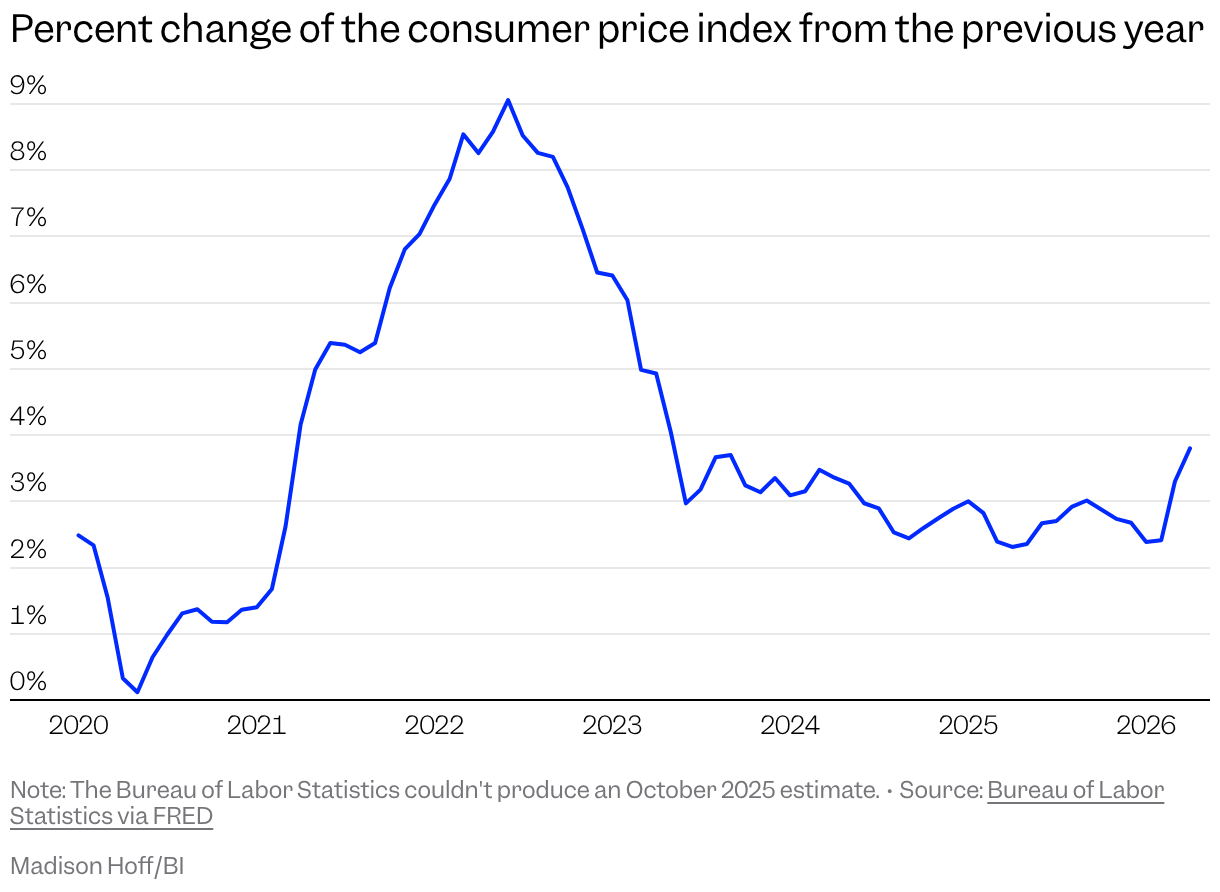
"The data suggests that the disinflation backdrop that has supported the bull market since the October 2022 bear low is no longer in place and instead has transitioned into an inflationary headwind," Rob Anderson, a strategist at the firm, and Thanh Nguyen, an analyst, said.
The research firm identified a handful of areas in the market that have historically weathered periods of hot inflation. Here were the top takeaways for investors:
Choose value stocks
An inflationary environment has tended to reward value stocks, both in cyclical and defensive sectors, the firm said.
In periods when inflation was rising, market gains were the most concentrated in energy, consumer staples, health care, and materials, according to NDR's analysis of sectoral performance dating back to 1972.
Historically, energy was the best-performing sector, posting a relative gain of 12%,
Those gains were followed by those in consumer staples (which posted a 4.3% relative increase) and health care (which posted a 4% increase).
Consider real estate, energy, materials, and industrials
In a hot inflation regime, earnings tend to be the strongest in real estate, energy, materials, and industrials.
The real estate sector has seen an average earnings per share growth rate of 34% in periods of rising inflation. The energy and materials sectors have typically seen earnings grow by about 30%, per NDR's analysis.
"The sectors have been the most sensitive to inflation generally, registering among the weakest earnings growth rates during falling inflation regimes as well. The statistics are likely not only picking up on the sectors' ability to pass along higher prices, but also the stronger economic message that often comes with higher inflation," the firm wrote.
Avoid financials
In periods when inflation is rising, financials have been the weakest sector "by a wide margin," the firm said, posting an average relative loss of 11%.
Financial stocks tend to be hurt in periods of hot inflation, as higher prices can cause rates to stay higher for longer as well. That can increase interest and funding costs while leading to portfolio losses, NDR added.
"Financials has been the biggest exception to the Growth/Value tendency. The sector has performed best in range-bound environments," the firm said.
Investors may be wary of the broader market when considering the outlook for Fed rate cuts, the firm suggested. Historically, when the Fed has paused its easing cycle for six months or more, the broader market sees a sharp pullback within the following four months, researchers said, citing their analysis of stock performance following a Fed pivot.
The Fed last cut rates in December, meaning the central bank's pause on monetary policy changes is approaching the six-month mark in June.
"The current case will likely fall into the pause category and has followed the typical correction pattern, albeit driven by the war with Iran. Equities tended to recover following the initial decline, on average," NDR added.
from Business Insider https://ift.tt/4uQPeX5
via IFTTT


Comments
Post a Comment