Few tech IPOs to list this year as Anthropic, SpaceX steal the spotlight
IPO
- Only a handful of venture-backed tech names are considering going public this year.
- In some cases, startups don't want to be outshone by the mega IPOs, SpaceX, and Anthropic.
- There are also reservations about going public close to a major election.
Two mega-IPOs are making 2026 look at first glance like a banner year for tech listings. Strip them out, and the IPO market is shaping up to be another dud.
"We will be a public company," Databricks CEO Ali Ghodsi told Bloomberg Television in June. "I just think this is a terrible year to go public." Databricks has been postponing its IPO for years.
SpaceX held the largest-ever IPO when it was valued at $1.75 trillion in June. Now Anthropic is looking to eclipse that, reportedly targeting a $2 trillion listing as soon as late September.
Yet, aside from these mega IPOs, only a handful of venture-backed tech names are considering debuts this year, according to people with knowledge of the fall calendar. Nsacle, Oura, and Strava have all been reported to be aiming to IPO this year, but the plans are in flux. OpenAI confidentially filed to go public in June, but delayed IPO plans until likely next year.
"I was optimistic 12 months ago that that narrative was going to change," said Alex Niehenke, a partner at Scale Venture Partners, referring to the lack of tech IPOs. "Unfortunately, it feels pretty broken right now."
The reasons are aplenty. In some cases, startups don't want to be outshone by the mega IPOs, bankers tell Business Insider. Public listings are often seen as marketing events, and it can be hard to attract attention — and capital — when you're 100 times smaller than the IPO the week before. The Federal Reserve has also moved in the opposite direction that many investors had hoped, raising interest rates rather than cutting them to combat inflation.
With the crucial US midterms on the horizon in November, there are also reservations about going public close to a major election, which could compress the available listing dates this fall amid market volatility around that time.
Some tech CEOs also see no need to go through the hassle of taking their company public when they can raise so much capital while still private. Databricks, founded in 2013, is the kind of fast-growing company that, in the past, would have gone public long ago. Instead, it just raised another $5 billion in strategic funding at a $190 billion valuation.
And then there's the question of investor appetite, especially after some of the biggest tech IPOs since last summer have been clobbered in the public markets. Figma, which makes collaborative design software used by product and engineering teams, is down nearly 80% since going public last July. Cerebras, an AI chipmaker that builds high-performance computing systems for training and running AI models, has fallen nearly 25% since its May debut. And Klarna, the Swedish fintech best known for its buy-now-pay-later products, has lost nearly 65% of its value since going public last September.
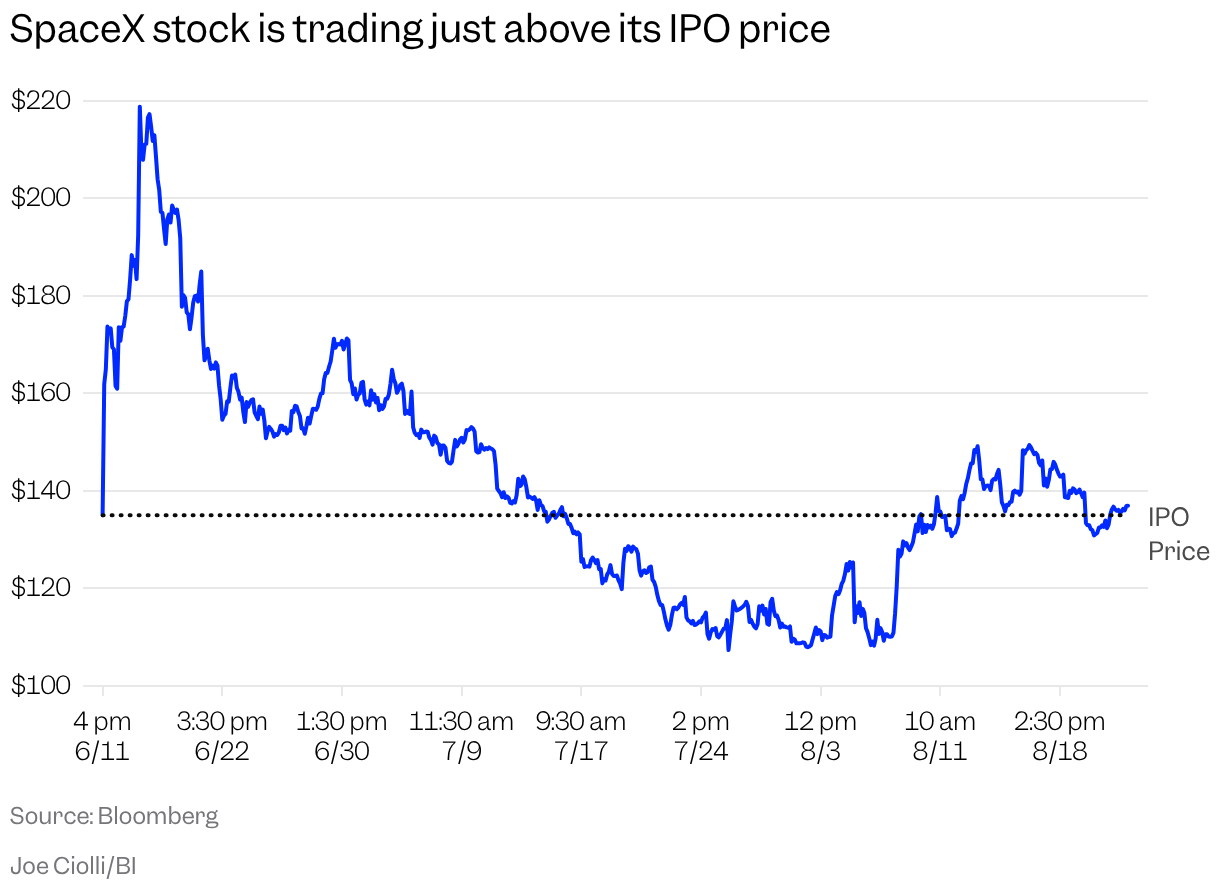
SpaceX stock has rebounded well off its lows, but is still down around 13% from its opening price.
"The window is open, but it is open for selective issuers," said Tegh Kapur, managing director of technology equity capital markets at JP Morgan. He said that the companies needed to have strong growth and margins, and that the top categories would include AI infrastructure, observability, and hardware. IPO-bound companies should usually have at least $250 million in revenue, he said.
There is demand for tech IPOs, but investors are a lot pickier than they were after many of 2021's IPOs and SPACs crashed and burned. To go public, you need to get the formula just right, bankers noted.
"This is a Goldilocks moment. Not too hot, not too cold: come in at a valuation the market can grow into," said Howard Gutman, Director of Private Equity Services at Highspring.
He cautioned that even companies with the right profile could scare away investors if bankers don't price the IPO perfectly. "Overprice at the top of the range and you get short-term volatility, momentum turns against you, and the stock swings the way SpaceX has. Underprice and you leave money on the table for the people who invest in the company."
Even with the war in Iran, rampant inflation, and skyrocketing bond prices, the S&P 500 has been trading at all-time highs this month. That should make companies feel confident about going public, according to Michael Gray, who leads Neal Gerber Eisenberg's Private Equity, Venture Capital & Growth Companies practice.
"There aren't many bears out there on the stock market right now," said Gray. "People are highly optimistic. Maybe too optimistic."
from Business Insider https://ift.tt/SW7hHmA
via IFTTT


Comments
Post a Comment